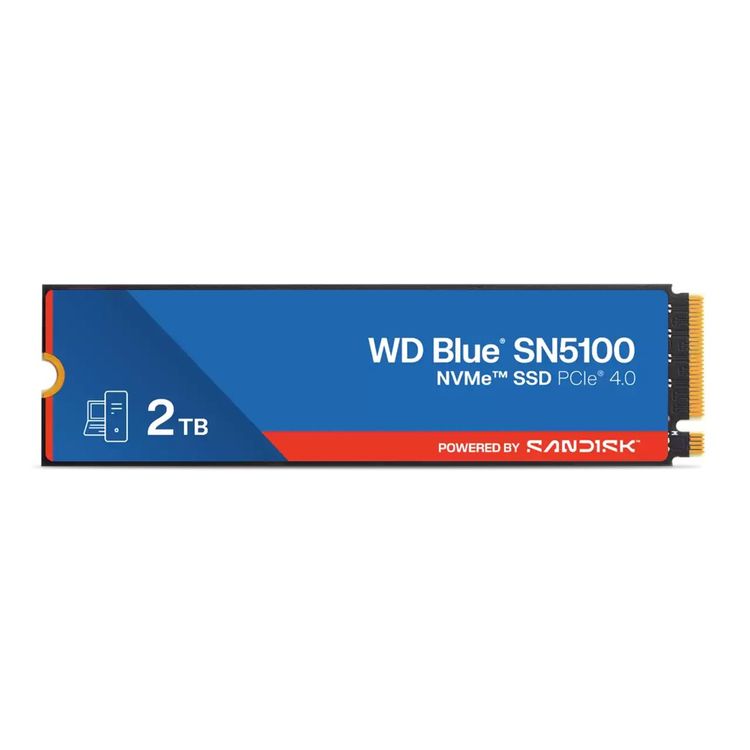
WD Blue SN5100 2TB NVMe SSD - WDS200T5B0E
The WD Blue SN5100 2TB NVMe SSD is a high-capacity PCIe 4.0 M.2 drive built for fast everyday creation, productivity and large-file workflows. With sequential read performance up to 7100MB/s and write performance up to 6700MB/s, it gives compatible desktops and laptops a responsive 2TB internal storage upgrade.
Key Selling Features
- 2TB capacity
- M.2 2280 form factor
- PCIe Gen 4.0 x4 NVMe interface
- Up to 7100MB/s sequential read
- Up to 6700MB/s sequential write
- Up to 1,000K random read IOPS and 1,300K random write IOPS
- 900TBW endurance rating
- SANDISK nCache 4.0 technology
Overview
Designed for systems with an M.2 2280 NVMe slot, the WD Blue SN5100 combines high sequential throughput with 2TB of space for applications, creative projects, games and working files. PCIe 4.0 support helps accelerate transfers and demanding storage workloads while retaining backward compatibility with earlier PCIe generations where supported by the host.
Specifications
- Model family: WD Blue SN5100
- Model: WDS200T5B0E / WDS200T5B0E-00CPE0
- Capacity: 2TB
- Form factor: M.2 2280
- Interface: PCIe Gen 4.0 x4, NVMe
- NAND: SANDISK QLC 3D CBA NAND
- Sequential read: up to 7100MB/s
- Sequential write: up to 6700MB/s
- Random read: up to 1,000K IOPS
- Random write: up to 1,300K IOPS
- Endurance: 900TBW
- Dimensions: 80 × 22 × 2.38mm
- Weight: 5.7g
- Operating temperature: 0°C to 85°C
- Non-operating temperature: -40°C to 85°C
Compatibility
Requires an M.2 2280 slot with NVMe support. Compatible with PCIe 4.0 and prior PCIe generations supported by the host system; performance is limited by the host interface.
In the Box
- WD Blue SN5100 2TB NVMe SSD
Warranty
5-year limited manufacturer warranty or the applicable endurance limit, whichever occurs first.
Share